Category Archives: Uncategorized

CMMI Announces the Cell and Gene Therapy Access Model

Today, the Centers for Medicare and Medicaid Innovation (CMMI) announced the launch of their new Cell and Gene Therapy Access Model, a demonstration aimed at improving access to cell and gene therapy products in the Medicaid program. CMMI chose sickle cell disease (SCD) as the first indication for the model. The intent of the model is to provide access to the two recently approved gene therapy products for SCD for individuals insured by Medicaid. Participation by state Medicaid programs will be optional.

SCDAA is excited about the model and appreciated that CMMI engaged with our organization and the broader SCD community while developing the demonstration. SCDAA will be reviewing the information released today in detail, but we are hopeful that this effort will help ensure that individuals living with SCD on Medicaid who are interested in pursuing gene therapy are able to do so.

To read the full statement from the Centers for Medicare & Medicaid Services, click here.

Gene Therapy: What You Need to Know (Warrior FAQs)

Two gene therapies were recently approved by the Food and Drug Administration (FDA) to treat sickle cell disease: Casegevy from CRISPR/Vertex and Lyfgenia from bluebird bio. You probably have questions about these new treatment options. Read more below.

Is gene therapy a cure for sickle cell disease?
Gene therapy is a potentially curative therapy. This means that it could act as a cure, but it is too new to say for sure. It causes a big decline in pain episodes, but we need to learn more about long-term impacts and side effects. It is also not a “one-and-done” treatment. The FDA currently recommends 15 years of patient follow up.

How does gene therapy work?
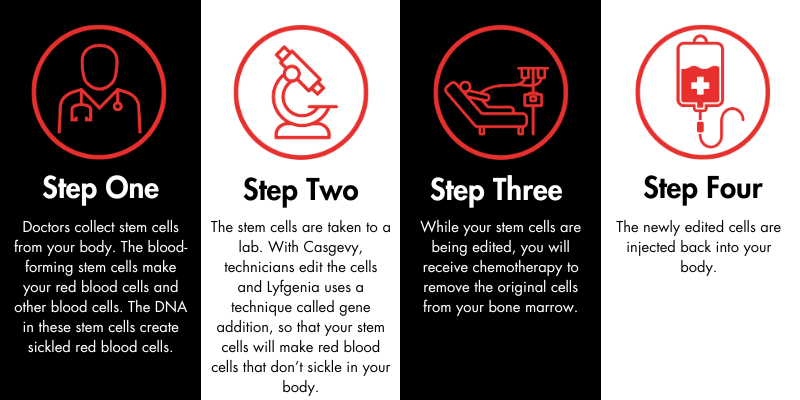
When will it be available?
Likely in early 2024.

Am I eligible for gene therapy?
Casgevy and Lyfgenia are approved for people ages 12 and up. Sickle cell disease SS and S-beta-zero-thalassemia are eligible. The FDA indicates that sickle cell disease SC is not included. Additionally, you may also not be able to receive gene therapy if you have:

  • A recurring viral infection
  • Significant organ damage

Additionally, if you have a matched sibling, you should go down the path of a matched-sibling-donor bone marrow transplant instead of gene therapy. Talk to your doctor about this option.

What are the side effects?
Gene therapy requires you to have chemotherapy. This means it could result in:

  • Infertility or secondary cancer
  • Temporary weakening of the immune system so that you cannot fight off any infections
  • Temporary hair loss

Where can I receive gene therapy?
Treatment will likely be at an existing bone marrow transplant center that also works with sickle cell disease experts. These may be hard to find. SCDAA will be providing a list of facilities, once identified, on our website: sicklecelldisease.org.

How much will it cost? Will insurance cover it?
Gene therapy is expensive, and FDA-approved high-cost medications can come with barriers. Casgevy is estimated to cost $2.2 million, and Lyfgenia is estimated to cost $3.1 million. We are still waiting to hear how insurance companies will handle gene therapies.

Does gene therapy work for all types of SCD?
As far as we know, yes. It is designed to be able to help raise fetal hemoglobin (HbF), which should work for all different kinds of sickle cell disease. However, the amount of experience with the different kinds has not been nearly the same – we know the most for SS and S Beta zero thalassemia types.

Are we the first community to receive gene therapy?
Casgevy is the first approved use of gene editing. However, gene addition therapy has been used to treat other conditions, including:

  • Retinal degeneration
  • Spinal muscular atrophy
  • Beta-thalassemia
  • X-linked Adrenoleukodystrophy
  • Hemophilia A & B
  • Bladder cancer
  • Acute-lymphoblastic leukemia

To learn more about the gene therapies used to treat these conditions, click here.

For a longer (but not complete) list of conditions that have been treated using gene therapy, click here.

Is it safe? How do I know if this is right for me?
For many people, the benefits of this new treatment outweigh the risks. Your doctors will help you determine whether this is a good option for you.

What questions should I ask my doctor?

  • How long will this take?
  • What is the time commitment?
  • Where is the nearest treatment center?
  • What are my other options?

How do I learn more about gene therapy?
There are several resources available. The below sources are considered trustworthy and non-biased by SCDAA.

To learn more about Vertex’s Casgevy, visit casgevy.com. To learn more about bluebird bio’s Lyfgenia, visit my bluebird support.

We encourage you to subscribe to our email list for news and updates.

Updated Dec. 14, 2023, at 11:09 a.m. EST


Please note: A previous version of this FAQ incorrectly stated that Casgevy is approved for people ages 12 and up and Lyfgenia is approved for those ages 12 to 50. This statement has been corrected to note that both Casgevy and Lyfgenia are approved for people ages 12 and up.
CDC SCD Pregnancy Fact Sheets

Learn more about how to stay healthy leading up to, during and after a pregnancy with these newly developed fact sheets from the Centers for Disease Control and Prevention (CDC), the Foundation for Women & Girls with Blood Disorders, the American Society of Hematology and the Sickle Cell Reproductive Health Education Directive.

NOW IN SPANISH!


In Memory of Dr. Lennette Benjamin

The Sickle Cell Disease Association of America, Inc., (SCDAA) is saddened to hear the news of the passing of Dr. Lennette Benjamin. Dr. Benjamin was a trailblazing physician who made many outstanding contributions to the sickle cell community. She was one of the first to establish a “day hospital” as an alternative to the emergency room for pain management – an approach that is today recognized as a best practice in care.  

Prior to her retirement, Dr. Benjamin led the Montefiore Sickle Cell Center for Adults in the Bronx, New York. She was an SCDAA board member emeritus and served on the SCDAA Medical and Research Advisory Committee. 

Dr. Benjamin was also a dedicated advocate and mentor. She made a global impact and raised sickle cell awareness in West Africa, Brazil and beyond. “She was always looking out for others, patients and peers alike,” recalls Dr. Lewis Hsu, SCDAA chief medical officer. “She was full of warm advice and expert guidance.”

Dr. Benjamin passed away in Houston, Texas on Oct. 20 at the age of 82. To share your sympathies, please click here.

SCDAA’s National Office and Board of Directors pay tribute to Dr. Benjamin’s outstanding life and career and send our deepest condolences to her family, friends and loved ones. 

New Opiate Dosing Calculator for Health Care Providers

NEW RESOURCE AVAILABLE: This tool from the National Alliance of Sickle Cell Centers can help sickle cell providers make important decisions about dosage when prescribing opiates. The calculator was developed was Paula Tanabe, RN, Ph.D., and Patricia Kavanagh, M.D., through a grant funded by the National Heart, Lung and Blood Institute. Click here to access the resource.

Click here to read the full study.  

SCDAA and MedicAlert Foundation Launch Pilot Program

Leading Sickle Cell Organization and MedicAlert Foundation Launch Pilot Program to Improve Emergency Care During Sickle Cell Pain Crises

Non-profits partner to help people with sickle cell disease get faster, better emergency care.


HANOVER, MD – Sickle Cell Disease Association of America (SCDAA), the leading national organization and voice for people with sickle cell disease (SCD), today launched a pilot program with MedicAlert Foundation to enhance the safety and well-being of people living with sickle cell disease (SCD).

Acute pain episodes known as sickle cell crises are one of the most common and debilitating symptoms of SCD. These crises can be unpredictable and extremely painful, lasting from a few hours to a few weeks. They’re the number one reason people with SCD seek emergency treatment.

However, SCD patients seeking treatment for a sickle cell crisis face hurdles to getting the care they need in the Emergency Department (ED). The goal of the pilot program is to improve access to timely, effective emergency care for people experiencing a sickle cell crisis.

The program provides participants with a MedicAlert digital health profile to store their physician-approved pain plan, physician contact information, and other vital health data. Each participant also receives a customized Smart Medical ID Card, which provides easy access to their health information and pain plan via a QR code.

The goal is to shortcut time to diagnosis and treatment. When seeking emergency treatment, participants will present their Smart ID Card to share their health history with ED personnel – confirming their SCD status, and providing the critical details needed for ED personnel to provide care.

“With more than 100,000 people in the U.S. living with SCD, finding an intervention to help improve the speed and quality of ED care would be hugely impactful,” said Regina Hartfield, President and CEO of SCDAA. “For this program, we’re leveraging Medicalert’s decades of experience providing medical information in emergencies – as well as MedicAlert’s visibility in the medical community – to help people living with sickle cell.”

MedicAlert Foundation is a leading nonprofit providing lifesaving medical ID and emergency response services for millions of people living with chronic health conditions.

“Since 1956, MedicAlert has been globally trusted by both emergency medical personnel and people living with serious health conditions,” stated Karen Cassel, MedicAlert Foundation’s President and CEO. “We’re pleased to launch this pilot during Sickle Cell Awareness Month. Our hope is to equip and empower SCD patients with tools to help them quickly get the care they need during a pain crisis.”

The pilot will run for one year. Two-hundred fifty adults in states with significant sickle cell populations are being recruited to participate in the first round.

“We believe this program has the potential to significantly improve outcomes for people experiencing sickle cell crises,” Hartfield said. “With positive results, we’ll seek additional funding to expand the program nationally.”

More details about the program, including full eligibility guidelines and how to apply, are available at medicalert.org/sicklecellpilot. Anyone living with SCD who has additional questions about the pilot should contact either their local SCDAA chapter, or email MedicAlert at sicklecellpilot@medicalert.org.  

Abstracts Accepted Until 11:59 p.m. PST

This morning, we were notified that some users experienced issues using our 2023 National Abstract Competition portal. This issue has been remedied. SCDAA is accepting abstract submissions until 11:59 p.m. PST, July 17, 2023. If you tried to submit an abstract earlier today and encountered a problem, please click here to resubmit your work before the deadline. Thank you for your patience.  

CMO Speaks: Gene Therapy for SCD (Part 1)

CMO Speaks is a blog featuring the voices of SCDAA’s clinical leadership team. Part 1 of our Gene Therapy series was written by Dr. Lewis Hsu and Dr. Sri Lakshmi Jamalapur.

How can you cure an inherited disease like sickle cell disease? One way would be to develop some extremely effective medications that would alleviate all the symptoms. Another would be to transplant stem cells that produce red blood cells. But the ultimate way to cure genetic disease is with gene therapy.

Gene therapy is a relatively new treatment for sickle cell warriors. Researchers began conducting experimental studies (clinical research) in people about seven years ago. At first, the only approach to this treatment was a process called “gene addition” developed by the Boston-based pharmaceutical company bluebird bio. Soon, several other groups joined with other approaches for gene therapy. By early 2022, there were six competing organizations enrolling in gene therapy clinical research. They are listed in the table below.

There has been a lot of news recently regarding gene therapy. Earlier this year, The New York Times published this article about gene therapy and sickle cell disease, which highlighted the voices and experiences of advocates from around our community and brought renewed attention to this pioneering treatment. Two pharmaceutical groups say that they will bring their gene therapy clinical research results to the U.S. Food and Drug Administration (FDA) for possible approval as safe and effective in the first quarter of 2023 (highlighted green in the table).

At the same time, in late February, three other groups announced that they are closing their gene therapy clinical research studies (highlighted yellow in the table). Some people worry that seeing companies end their gene therapy studies is not good news for sickle cell disease. However, another way to look at these announcements is that the most fruitful studies are heading toward possible FDA approval. Less productive clinical research efforts are cutting their losses and being pruned away.

It’s like a gardener doing work in a little garden to keep the plants that are bearing fruit (the two groups that will bring their results to U.S. FDA) alive but removing those plants that have stopped growing (the groups that are closing their gene therapy clinical research). The wisdom of pruning down the less productive activity is recognized by many proverbs, including “if you run after two hares, you will catch neither,” or “have too many irons in the fire,” or “he who tries to sit on two chairs will end up sitting on neither,” or John 15:1 in the Bible. Drop-out studies are part of the healthy competitive process of research and investment.

Table 1: Current and upcoming studies of gene therapy in SCD. (adapted from Kanter and Falcon 2021; Hsu and Jamalapur 2022) N/A – not applicable; LVV – lentiviral vector; HbAT87Q – Hb with a single mutation conferring most of the antisickling effect of γ-globin; βAS3 – an antisickling β-globin containing 3 amino acid substitutions in the wild-type HBB; HbFG16D – modified HbF that increases affinity to α-globin to outcompete sickle mutated β-globin; AAV6 – Adeno-Associated Virus serotype 6.

Outside of gene therapy studies, promising sickle cell progress is everywhere. Researchers are developing innovative medications and studying stem cell transplants that could make a world of difference to warriors who are unable or unwilling to undergo gene therapy in the future. The clinical research process is fine-tuned to determine which treatments are safe and effective. Sickle cell warriors are encouraged to help push this research forward by participating in clinical trials.


Lewis Hsu, MD, PhD, is a pediatric hematologist who serves as director of the Sickle Cell Center and professor of pediatrics for the University of Illinois at Chicago. He has conducted sickle cell research, published over 50 peer-reviewed papers and co-authored “Hope and Destiny: The Patient and Parent’s Guide to Sickle Cell Disease and Sickle Cell Trait.” He currently serves as the SCDAA Chief Medical Officer.

Sri Lakshmi Jamalapur, MD, is a pediatric hematologist and the new leader for the Pediatric Sickle Cell Center at Children’s Hospital of Michigan in Detroit. She has collaborated with Dr. Hsu on health education and sickle cell advocacy since 2019.  

June 19, 2023, is Officially Sickle Cell Awareness Day in Maryland!

Maryland Governor Wes Moore has signed a proclamation to make June 19, 2023, Sickle Cell Awareness Day! This recognition goes a long way in raising awareness about sickle cell disease, combating prejudices and lifting up our community. Thank you for supporting our cause and helping us to “Shine the Light on Sickle Cell Disease!”