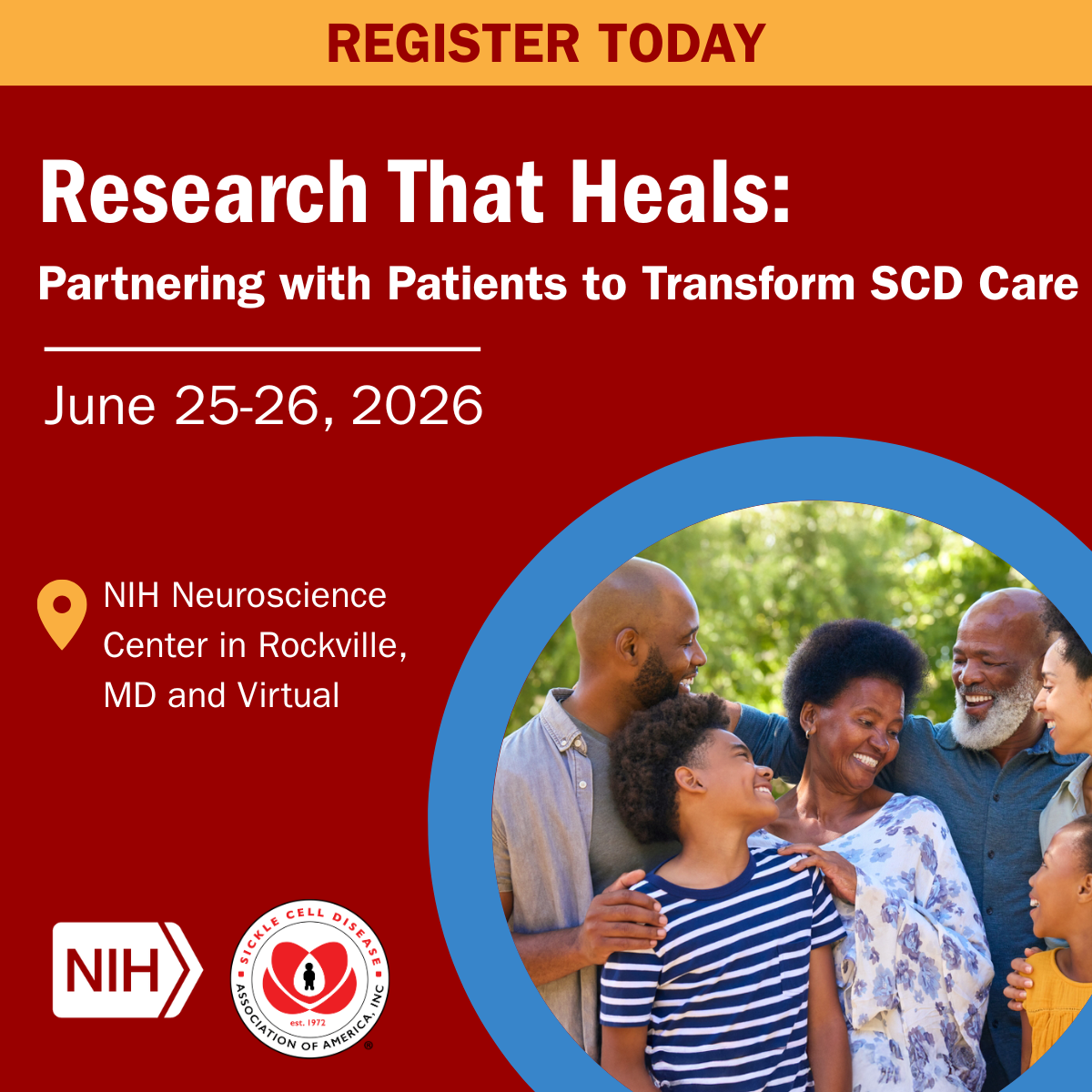
The National Heart, Lung, and Blood Institute (NHLBI), part of the National Institutes of Health (NIH), in partnership with the Sickle Cell Disease Association of America, Inc. (SCDAA), will host Research That Heals: Partnering to Transform SCD Care on June 25-26, 2026. This 1.5-day hybrid (in-person and virtual) community forum will be a crucial platform for engaging directly with the sickle cell disease (SCD) community, including individuals with SCD and their caregivers, healthcare providers and community-based organizations. During the forum, participants will discuss and develop solutions to enhance care and improve the quality of life for children and adults living with sickle cell disease.
Author Archives: Emma Day
2026 National Abstract Competition
If you are a researcher, community-based member organization, physician, nurse, social worker or someone working on behalf of people living with sickle cell disease and their families, the Sickle Cell Disease Association of America, Inc. would like to highlight your work at the 54th Annual National Convention, October 15-17, 2026, in-person.
To be eligible, abstracts must meet guidelines and be submitted by June 22, 2026. Late submissions will not be accepted. Abstracts will be reviewed and ranked by the national abstract review committee. We hope to notify you of acceptance beginning July 24, 2026. Abstract finalists will be judged during oral presentations and presented at the SCDAA Gala (Friday evening, October 16th)
“Best Abstract” in each category will be announced at the SCDAA 54th Annual National Convention. Special awards for the best student and trainee abstracts will also be given.
Submission Instructions and Guidelines
Abstract text must be written in English and contain the following:
- TITLE: Use a concise title typed in CAPITAL LETTERS.
- AUTHORS: List authors’ names (First name, middle initial, last name) and institutional affiliations as briefly as possible. Indicate authors who are trainees (such as student, grad student, post-doctoral fellow, intern, resident, apprentice, etc.) and list them first if the work is their project.
- ABSTRACT TEXT:
- Structure text utilizing the following subheadings: Objective, Methods, *Results, and Conclusions.
- Submit abstracts in written form for scoring.
- Authors can be modified to have less duplication of contact information for co-authors.
- Abstracts without results will not be accepted.
- Please do not submit tables or charts with your abstract.
- ABSTRACT CATEGORY: If your abstract seems to fit more than one category, please select a first choice and a second choice – the abstract judges will decide.
- CHARACTER COUNT: 5000 characters maximum (no exceptions).
2026 Presentations, Topic Categories, and Examples
Categories for abstract judging are listed here. Trainee presentations are a subcategory of each topic. If your abstract seems to fit more than one topic category, please select a first choice and a second choice – the abstract judges will decide which category fits best.
- Public Health Policy
- Community-Based Research
- Basic and Translational Research
- Clinical Research
- Psychosocial Research
- Gene Therapy Hematopoietic Stem Cell Transplant
- SCD Global Health
- Sickle Cell Trait
Novo Nordisk Announces Promising Topline HIBISCUS Study Results
In an announcement, Novo Nordisk shared that Etavopivat is the first in a new class of drugs to meet both co-primary endpoints in the phase 3 HIBISCUS trial, substantially reducing vaso-occlusive crisis events and improving hemoglobin response in sickle cell disease. SCDAA is pleased to hear this news. We will continue to monitor these developments and look forward to learning more about the results of this study.
SCDAA Masterclass (Hosted by Agios Cheat Codes) Now Available
Our final 2025 SCDAA Masterclass – Sickle Cell in the Media: Scene & Heard (Hosted by Agios Cheat Codes) – is now available! Recorded live at the 2025 SCDAA Convention in Chicago, this special Masterclass dives into how sickle cell disease is portrayed in film, TV and beyond.
From blockbuster films to powerful documentaries, our panelists (patients, advocates and filmmakers) unpack how storytelling can change minds, challenge stigma and build connection. Featuring voices from the sickle cell community, this is one conversation you don’t want to miss.
SCD Advocacy Update: March 2026
CONGRESS PASSES FISCAL YEAR 2026 FUNDING PACKAGE WITH BIG WINS FOR THE SICKLE CELL DISEASE COMMUNITY
In early February, Congress finally advanced, and the President signed into law, a funding package for federal programs for fiscal year (FY) 2026, which runs through September 30, 2026. All three federal sickle cell disease programs — Health Resources and Services Administration’s (HRSA’s) Sickle Cell Disease Treatment Demonstration Program, HRSA’s Sickle Cell Disease Newborn Screening Follow Up Program and the Centers for Disease Control and Prevention’s (CDC) Sickle Cell Data Collection Program — were maintained with the same funding levels as FY25.
The funding package also included the Sickle Cell Disease and Other Heritable Blood Disorders Research, Surveillance, Prevention, and Treatment Act (H.R. 1796/S. 735) which reauthorizes HRSA’s SCD Treatment Demonstration Program for another five years. SCDAA has been working to advance this legislation since it was introduced in the 118th Congress. Thank you to all who have advocated for this legislation and a special thanks to our Congressional champions Senators Tim Scott (R-SC) and Cory Booker (D-NJ); and Representatives John James (R-MI-10), Danny Davis (D-IL-07), Jen Kiggans (R-VA-2), Troy Carter (D-LA-2) and Marc Veasy (D-TX-33) for helping to get this bill across the finish line.
SCDAA TURNS FOCUS TO FUNDING FOR FY27
Now that funding for FY26 is wrapped up, SCDAA has begun advocating to secure funding for sickle cell disease federal programs for FY27. SCDAA has secured a bipartisan effort in the House of Representatives — Reps. Danny Davis (D-IL) and Jen Kiggans (R-VA) are leading a letter in support of FY27 funding for the federal sickle cell programs. We are also working with staff for Sens. Booker (D-NJ) and Scott (R-SC) and are hopeful that they will send a letter to the Senate Appropriations Committee as they have done in the past. Several Members of Congress have asked SCDAA to complete their Appropriation’s request forms, which shows broader support for the federal SCD programs. These requests and letters of support from Members of Congress to the relevant Appropriations Committees are an important step in securing funding for federal programs.
SCDAA ENGAGES WITH FEDERAL AND STATE MEDICAID PROGRAMS ON WORK REPORTING REQUIREMENTS
SCDAA is closely tracking the coming changes to the Medicaid program. In December, SCDAA met with staff at the Centers for Medicare and Medicaid Services (CMS) to talk about the coming work-reporting requirements and to request that individuals living with sickle cell disease are exempt from these requirements. Since then, SCDAA has sent a follow-up letter to CMS as well as to all state Medicaid directors providing information about sickle cell disease and again, requesting that individuals with sickle cell disease are exempt from these requirements.
States are required to implement work-reporting requirements as a basis of Medicaid eligibility for certain beneficiaries by January 1, 2027, although some states have indicated that they will get started sooner (Nebraska is set to implement as soon as May 1, 2026). Federal guidance is anticipated in June, although implementation details will likely be left up to the states. SCDAA will continue to provide information to members as it becomes available.
SCDAA continues to encourage members to engage with their state Medicaid programs. SCDAA will be sharing information soon about state Medicaid Advisory Committees and Beneficiary Advisory Councils, which are now mandatory in each state, and provide an opportunity for the public to weigh in on Medicaid policy.
OUTREACH TO SOCIAL SECURITY ADMINISTRATION ON DISABILITY EVALUATIONS
In early February, SCDAA joined other sickle cell disease advocacy organizations, including Sick Cells and the American Society of Hematology, in a letter to the Social Security Administration (SSA) requesting again that the agency update the existing criteria used to evaluate sickle cell warriors to determine eligibility for disability benefits. The letter specifically requested that the agency review the report issued by the National Academies in December 2025, which includes strong support for revising the current criteria used by SSA. The agency responded that they are actively reviewing the report. SCDAA will continue to push for these criteria to be updated to better reflect current treatment practices and the reality of living with sickle cell disease.
MedicAlert Foundation, SCDAA & Fulcrum Therapeutics Partner
Supported by:
MedicAlert Foundation, Sickle Cell Disease Association of America, Inc. (SCDAA) and Fulcrum Therapeutics Partner to Accelerate Emergency Department Access to Critical Care Information for People Living with Sickle Cell Disease
Three-year collaboration is aimed at enhancing a key aspect of sickle cell management: expediting care during a pain crisis
March 19, 2026 — MedicAlert Foundation, the leading nonprofit providing medical IDs and emergency medical information services, Sickle Cell Disease Association of America, Inc., (SCDAA), the national voice for people affected by sickle cell disease and their caregivers, and Fulcrum Therapeutics Inc. (Fulcrum) (Nasdaq: FULC), a leader in advancing therapies for underserved patient populations, today announced a new partnership designed to help streamline and expedite emergency department (ED) care for people living with sickle cell disease (SCD) through rapid access to patient-specific care plans.
Individuals living with SCD, an inherited blood disorder, frequently seek care in EDs during acute pain crises. In these urgent care situations, immediate access to health information is a vital step in helping clinicians deliver the timely, targeted care that people with SCD need.
“Too often, individuals living with SCD face barriers to receiving appropriate and compassionate care quickly during a pain crisis in the emergency department,” said Regina Hartfield, President and CEO, SCDAA. “This partnership represents an important step forward in this program, originally launched in 2023 between MedicAlert and SCDAA. Fulcrum’s commitment will enable us to broaden our reach into SCDAA’s membership and to the SCD community and will empower so many more individuals living with SCD with a trusted way to effectively share their care and/or pain plans and medical information with emergency clinicians, helping ensure their voices and needs are recognized when they seek care.”
Through this program, participants receive a MedicAlert Smart Medical ID Card linked to a secure digital health profile. When the card’s QR code is scanned by ED personnel, clinicians can quickly access essential medical information including the patient’s physician-approved sickle cell pain plan, hematologist contact information, medications, allergies, and other vital health data.
“When a person with SCD comes to the ED during a pain crisis, lack of access to patient-specific care plans can result in prolonged suffering,” said Karen Cassel, President and CEO, MedicAlert Foundation “That’s where our emergency response system comes in. It’s designed to help address this pain point by enabling faster clinical decision-making.”
SCD is long overdue for improvements in care coordination to help ease the burden of this painful and devastating disease that affects nearly 100,000 people in the U.S., many of whom have been left behind amid the shortcomings in the current landscape. The often unmet needs of patients necessitate urgency to adopt new and unique collaborations that help close the gap in their experiences.
“At Fulcrum, we are committed not only to developing innovative therapies, but also to advancing solutions that improve the entire care journey for people living with SCD,” said Alex Sapir, CEO, Fulcrum Therapeutics. “Through this partnership, we hope to help solve some of the most pervasive challenges people living with SCD face and reduce delays in care when minutes matter most.”
For those living with SCD who are interested in learning more or securing a MedicAlert Smart Medical ID Card through this partnership, please visit www.medicalert.org/sicklecellpilot.
About Fulcrum Therapeutics
Fulcrum Therapeutics is a clinical-stage biopharmaceutical company focused on developing small molecules to improve the lives of patients with genetically defined rare diseases in areas of high unmet medical need. Fulcrum’s lead clinical program is pociredir, a small molecule designed to increase expression of fetal hemoglobin for the treatment of sickle cell disease. Fulcrum uses proprietary technology to identify drug targets that can modulate gene expression to treat the known root cause of gene mis-expression. For more information, visit www.fulcrumtx.com
About the Sickle Cell Disease Association of America
The Sickle Cell Disease Association of America, Inc. (SCDAA) advocates for people affected by sickle cell conditions and empowers community-based organizations to maximize quality of life and raise public consciousness while advancing the search for a universal cure. The association and its more than 50 member organizations support sickle cell research, public and professional health education and community services. (www.sicklecelldisease.org)
About MedicAlert Foundation
The MedicAlert Foundation is a global nonprofit organization dedicated to protecting and saving lives by providing trusted medical identification and emergency health information services. MedicAlert’s secure digital health profiles and medical ID products ensure that critical health information is available to first responders and healthcare providers during medical emergencies. For more information, visit www.medicalert.org
In Remembrance of KiKi Shepard
The Sickle Cell Disease Association of America, Inc. (SCDAA) mourns the loss of KiKi Shepard, an actress and dedicated sickle cell advocate, who passed away recently at the age of 74. Many knew KiKi as a longtime co-host of the “Showtime at the Apollo” variety show, but she was also the founder of sickle cell nonprofit The KIS Foundation and worked closely with many individuals and organizations in the SCD community, including SCDAA.
In a letter on her website, KiKi says that her advocacy journey began “when I saw the effect on the family of a personal friend whose brother suffered and died as a result of this terrible disease. The strong desire to combat my shared grief and sense of helplessness led me to offer my services to the Sickle Cell Disease Association of America, Inc. Through this national organization, I was introduced to SCD families across America and was able to interact with many patients whose bodies and minds are ravaged by this disease.”
KiKi worked closely with SCDAA until she founded her own organization in the mid-2000s. She served as the moderator of the Lonzie Lee Jones Symposium at the 38th Annual National Convention in 2010 and remained active in the SCD advocacy space throughout her life.
According to a statement released by her family, “KiKi believed that compassion, community and education could change lives. Her voice uplifted countless individuals who often felt unseen, and her work created lasting pathways for hope, resources and understanding for those living with this disease.”
Thank you, KiKi, for your commitment to our cause. We send our sincere condolences to her friends and family for their loss.
Fulcrum Therapeutics to Host Congressional Briefing
Understanding the Need for Improved Patient Access to Sickle Cell Disease Treatment Options
Hosted by Fulcrum Therapeutics
Thursday, March 19, 2026
10:00 to 11:00 AM ET
Rayburn House Office Building, Room 2043
This briefing will bring together clinicians, patient advocates, researchers, and policy leaders for a moderated panel discussion on the current treatment landscape for sickle cell disease and what Congress can do to improve access and outcomes for the 100,000 Americans living with this condition. SCDAA President and CEO Regina Hartfield is one of four featured panelists.
Sickle cell disease disproportionately impacts Black and Latino communities and remains one of the most underfunded and under-resourced conditions in federal health policy. This is a conversation worth being in the room for.

Black History Month 2026: Dr. Charles Drew
Our final #SCDHistoryHighlight of 2026 explores the life and career of Dr. Charles Drew, a pioneering physician whose work paved the way for our modern-day blood banking system. Thanks to his research, individuals with sickle cell disease have access to safe and timely blood transfusions.
Dr. Drew was born in 1904 in Washington, D.C. He was a talented athlete and earned a partial scholarship to Amherst College in Massachusetts, where he was one of the few African Americans on campus. After graduating, he taught biology and coached at Morgan College (now Morgan State University) before attending medical school at McGill University in Canada. During his residency at Montreal Hospital, he developed an interest in blood transfusions and their effectiveness in treating shock.
He began his medical career at Howard University, practicing as a faculty instructor for pathology and later taking an appointment at the Freedman’s Hospital as a surgeon. In 1940, he completed his postdoctoral studies at Columbia University and became the first African American to earn a Doctor of Science in Medicine degree.
His postdoctoral thesis, titled “Banked Blood: A Study on Blood Preservation,” determined how to process and preserve blood plasma — a strategy that increased the length of time that blood could be stored. This research was completed in time to be of great use during World War II, and Dr. Drew led efforts to collect, preserve and internationally ship approximately 14,500 liters of blood through the Blood for Britain campaign.
In 1941, Dr. Drew was appointed assistant director of the first American Red Cross Blood Bank. During his time with the organization, he invented the “bloodmobile,” which allowed blood to be collected and transported on-the-go. Dr. Drew strongly objected to the blood bank segregating their blood storage and ultimately resigned from his position in protest of this racist policy.
Dr. Drew went on to rejoin faculty at Howard University, where he worked until he tragically passed away in a car accident at the age of 45. Dr. Drew’s research lay the foundation for safe and accessible blood transfusions, and his advocacy promoted equity in medicine — key elements of wellness for individuals with sickle cell disease across the globe.