
Tag Archives: Gene Therapy

Gene Therapy: What You Need to Know (Warrior FAQs)

Two gene therapies were recently approved by the Food and Drug Administration (FDA) to treat sickle cell disease: Casegevy from CRISPR/Vertex and Lyfgenia from bluebird bio. You probably have questions about these new treatment options. Read more below.

Is gene therapy a cure for sickle cell disease?
Gene therapy is a potentially curative therapy. This means that it could act as a cure, but it is too new to say for sure. It causes a big decline in pain episodes, but we need to learn more about long-term impacts and side effects. It is also not a “one-and-done” treatment. The FDA currently recommends 15 years of patient follow up.

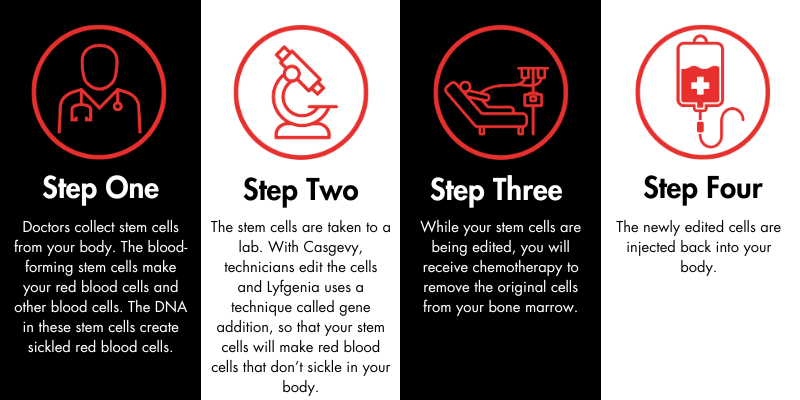
How does gene therapy work?
When will it be available?
Likely in early 2024.

Am I eligible for gene therapy?
Casgevy and Lyfgenia are approved for people ages 12 and up. Sickle cell disease SS and S-beta-zero-thalassemia are eligible. The FDA indicates that sickle cell disease SC is not included. Additionally, you may also not be able to receive gene therapy if you have:

  • A recurring viral infection
  • Significant organ damage

Additionally, if you have a matched sibling, you should go down the path of a matched-sibling-donor bone marrow transplant instead of gene therapy. Talk to your doctor about this option.

What are the side effects?
Gene therapy requires you to have chemotherapy. This means it could result in:

  • Infertility or secondary cancer
  • Temporary weakening of the immune system so that you cannot fight off any infections
  • Temporary hair loss

Where can I receive gene therapy?
Treatment will likely be at an existing bone marrow transplant center that also works with sickle cell disease experts. These may be hard to find. SCDAA will be providing a list of facilities, once identified, on our website: sicklecelldisease.org.

How much will it cost? Will insurance cover it?
Gene therapy is expensive, and FDA-approved high-cost medications can come with barriers. Casgevy is estimated to cost $2.2 million, and Lyfgenia is estimated to cost $3.1 million. We are still waiting to hear how insurance companies will handle gene therapies.

Does gene therapy work for all types of SCD?
As far as we know, yes. It is designed to be able to help raise fetal hemoglobin (HbF), which should work for all different kinds of sickle cell disease. However, the amount of experience with the different kinds has not been nearly the same – we know the most for SS and S Beta zero thalassemia types.

Are we the first community to receive gene therapy?
Casgevy is the first approved use of gene editing. However, gene addition therapy has been used to treat other conditions, including:

  • Retinal degeneration
  • Spinal muscular atrophy
  • Beta-thalassemia
  • X-linked Adrenoleukodystrophy
  • Hemophilia A & B
  • Bladder cancer
  • Acute-lymphoblastic leukemia

To learn more about the gene therapies used to treat these conditions, click here.

For a longer (but not complete) list of conditions that have been treated using gene therapy, click here.

Is it safe? How do I know if this is right for me?
For many people, the benefits of this new treatment outweigh the risks. Your doctors will help you determine whether this is a good option for you.

What questions should I ask my doctor?

  • How long will this take?
  • What is the time commitment?
  • Where is the nearest treatment center?
  • What are my other options?

How do I learn more about gene therapy?
There are several resources available. The below sources are considered trustworthy and non-biased by SCDAA.

To learn more about Vertex’s Casgevy, visit casgevy.com. To learn more about bluebird bio’s Lyfgenia, visit my bluebird support.

We encourage you to subscribe to our email list for news and updates.

Updated Dec. 14, 2023, at 11:09 a.m. EST


Please note: A previous version of this FAQ incorrectly stated that Casgevy is approved for people ages 12 and up and Lyfgenia is approved for those ages 12 to 50. This statement has been corrected to note that both Casgevy and Lyfgenia are approved for people ages 12 and up.

Gene Therapy is Approved!

We are very excited to share that today, Dec. 8, the Food and Drug Administration approved two gene therapies to treat sickle cell disease! These potentially curative therapies are the first treatments of their kind available to individuals with SCD. We are heartened by this approval and are proud to support our community during this milestone moment. SCDAA will be releasing a full statement and additional information for patients and caregivers soon. To learn more about these approvals, click here.


SCDAA Statement About Gene Therapy Approval

On Dec. 8, 2023, the Food and Drug Administration (FDA) approved two cell-based gene therapies for sickle cell disease (SCD), Casgevy from CRISPR/Vertex and Lyfgenia from bluebird bio. These are the first treatments of their kind available to individuals with SCD in the United States. SCDAA welcomes the approval of these potentially curative therapies which mark major advances in the treatment of sickle cell disease; however, there are valid concerns about accessibility and the potential for adverse effects.

Dr. Lewis Hsu, chief medical officer of the Sickle Cell Disease Association of America Inc. said:

We at the Sickle Cell Disease Association of America Inc. celebrate that two gene therapies are approved for sickle cell disease by the FDA today, Dec. 8. This double milestone was a long time coming, and sickle cell disease now joins the ranks of other genetic diseases with gene therapy treatments. Sickle cell disease was called “the first molecular disease” about 70 years ago, and a gene therapy treatment was predicted for sickle cell disease in the 1950s when DNA was first described.

These two gene therapies mark a big step forward for sickle cell disease research and treatment. The results of the clinical trials are very impressive. The patients selected had a lot of pain (two or more vaso-occlusive crisis pain hospitalizations per year for two years). The data show that, after gene therapy was administered, nearly all patients were free of hospitalizations for vaso-occlusive crises for at least nine consecutive months. The patients’ health-related quality of life also improved in every way: physically, emotionally, socially and functionally with both gene therapies.

Regina Hartfield, president and CEO of the Sickle Cell Disease Association of America Inc. said:

Gene therapy is an exciting and potentially curative addition to the treatments available to sickle
cell warriors. This is a historic milestone, but everyone may not be eligible for gene therapy.
We must continue to move forward with research to ensure that there is a solution for every member of our community.

Is gene therapy a cure for sickle cell disease?
The Sickle Cell Disease Association of America Inc. recognizes gene therapy as a “potentially curative” therapy. The treatment is so new that more data is needed to understand its impact and patient prognosis. Additionally, the word “cure” suggests a simple solution that does not reflect the reality of these therapies. Even after completing treatment, the FDA recommends 15 years of patient monitoring for health issues.

What is the treatment like?
The patient journey will be similar for both Casgevy and Lyfgenia. Gene therapy is administered during a one-time infusion; however, there are steps that patients must take to prepare for the treatment. First, the patient’s care team will collect stem cells, which are the progenitors of red blood cells, from their body. Then, those cells will be treated in a lab. The patient will undergo chemotherapy to remove the original, abnormal stem cells from the bone marrow. After this process is complete, the treated stem cells are injected back into the patient through an intravenous process like a transfusion (not surgery). The whole procedure takes about a year. It is similar to autologous bone marrow transplantation, as there is no need to find a donor of stem cells.

What is the difference between the two therapies?
The two gene therapy strategies are scientifically different. Casgevy is gene editing, the first of its kind, and Lyfgenia uses gene addition. Both gene therapy strategies have about the same patient journey and potential issues: access, cost, infertility, unknown possibility of organ damage and unknown long-term effects.

How effective is it?
Gene therapy provides a significant reduction in acute episodes of sickle cell pain within a few years of administration. More years of follow-up will be needed to determine whether it will also reduce the organ damage of sickle cell disease and if the stem cells treated with continue to produce non-sickling red blood cells for the rest of the person’s life, or if the stem cells die off over a certain number of years. Currently the treatment requires chemotherapy, which means there are also concerns about chemotherapy-associated complications, such as infertility or secondary cancer.

When will gene therapy be available for use?
Gene therapy will likely be available in early 2024.

Who is eligible?
Casgevy and Lyfgenia are approved for people ages 12 and up. Sickle cell disease SS and S-beta-zero-thalassemia are eligible. The FDA indicates that sickle cell disease SC is not included. Additionally, individuals may also not be able to receive gene therapy if they have:

  • A recurring viral infection
  • Significant organ damage

Where is gene therapy administered?
Individuals with SCD can receive gene therapy at existing bone marrow treatment facilities with sickle cell expertise, which may pose accessibility issues to patients. SCDAA encourages gene therapy centers to partner with sickle cell centers, such as in the National Alliance of Sickle Centers, so that there is expertise to monitor for sickle cell organ damage.

How much will it cost? Will insurance cover gene therapy?
Gene therapy treatments are produced through expensive, highly technical processes. Casgevy is estimated to cost $2.2 million, and Lyfgenia is estimated to cost $3.1 million. However, the high price should be worthwhile as the savings in lifelong care may exceed the one-time cost of gene therapy. FDA-approved high-cost medications come with insurance barriers and rules that are not evidence-based.

What do these approvals mean for people living with sickle cell?
These approvals are expected to be life-changing for many and usher in a new age of treatment for sickle cell disease. Until now, the only way to cure sickle cell disease was through a bone marrow transplant, which is not a widely accessible option because it requires a matched bone marrow donor. Gene therapy does not require a donor; therefore, it has the potential to be a more widely available treatment.

What does it mean for sickle cell treatment in the future?
Casgevy and Lyfgenia are the first gene therapy treatments approved by the FDA for sickle cell disease. They open the door for other gene therapies to gain approval and help advance research into other potentially curative treatments. At the same time, there are concerns that these approvals will create an increase in competition for health care resources that could make it difficult to access other forms of treatment outside of gene therapy. Many people will not be eligible to receive gene therapy. To provide the highest quality of care to these individuals, we need to continue research into a variety of treatment options beyond gene therapy.

What are the implications for the medical community at large?
More broadly, Casgevy is the first FDA-approved CRISPR gene editing therapy for a genetic disease. This could have wide-reaching impacts for individuals with other conditions like cystic fibrosis, Tay-Sachs disease and others.

Where can I find more information?
Research into Casgevy and Lyfgenia specifically is ongoing; however, there is a wide variety of information about gene therapy for sickle cell disease available as it relates to clinical trials.

To learn more about Vertex’s Casgevy, visit casgevy.com. To learn more about bluebird bio’s Lyfgenia, visit my bluebird support.

Updated Dec. 14, 2023, 11:12 a.m. EST

SCDAA Statement About Gene Therapy Approval

The Food and Drug Administration (FDA) approved two cell-based gene therapies for sickle cell disease (SCD), Casgevy from CRISPR/Vertex and Lyfgenia from bluebird bio. These are the first treatments of their kind available to individuals with SCD in the United States. SCDAA welcomes the approval of these potentially curative therapies which mark major advances in the treatment of sickle cell disease; however, there are valid concerns about accessibility and the potential for adverse effects.

Dr. Lewis Hsu, chief medical officer of the Sickle Cell Disease Association of America Inc. said:
We at the Sickle Cell Disease Association of America Inc. celebrate that two gene therapies are approved for sickle cell disease by the FDA today, Dec. 8. This double milestone was a long time coming, and sickle cell disease now joins the ranks of other genetic diseases with gene therapy treatments. Sickle cell disease was called “the first molecular disease” about 70 years ago, and a gene therapy treatment was predicted for sickle cell disease in the 1950s when DNA was first described.

These two gene therapies mark a big step forward for sickle cell disease research and treatment. The results of the clinical trials are very impressive. The patients selected had a lot of pain (two or more vaso-occlusive crisis pain hospitalizations per year for two years). The data show that, after gene therapy was administered, nearly all patients were free of hospitalizations for vaso-occlusive crises for at least nine consecutive months. The patients’ health-related quality of life also improved in every way: physically, emotionally, socially and functionally with both gene therapies.

Regina Hartfield, president and CEO of the Sickle Cell Disease Association of America Inc. said:
Gene therapy is an exciting and potentially curative addition to the treatments available to sickle cell warriors. This is a historic milestone, but everyone may not be eligible for gene therapy. We must continue to move forward with research to ensure that there is a solution for every member of our community.

Is gene therapy a cure for sickle cell disease?
The Sickle Cell Disease Association of America Inc. recognizes gene therapy as a “potentially curative” therapy. The treatment is so new that more data is needed to understand its impact and patient prognosis. Additionally, the word “cure” suggests a simple solution that does not reflect the reality of these therapies. Even after completing treatment, the FDA recommends 15 years of patient monitoring for health issues.

What is the treatment like?
The patient journey will be similar for both Casgevy and Lyfgenia. Gene therapy is administered during a one-time infusion; however, there are steps that patients must take to prepare for the treatment. First, the patient’s care team will collect stem cells, which are the progenitors of red blood cells, from their body. Then, those cells will be treated in a lab. The patient will undergo chemotherapy to remove the original, abnormal stem cells from the bone marrow. After this process is complete, the treated stem cells are injected back into the patient through an intravenous process like a transfusion (not surgery). The whole procedure takes about a year. It is similar to autologous bone marrow transplantation, as there is no need to find a donor of stem cells.

What is the difference between the two therapies?
The two gene therapy strategies are scientifically different. Casgevy is gene editing, the first of its kind, and Lyfgenia uses gene addition. Both gene therapy strategies have about the same patient journey and potential issues: access, cost, infertility, unknown possibility of organ damage and unknown long-term effects.

How effective is it?
Gene therapy provides a significant reduction in acute episodes of sickle cell pain within a few years of administration. More years of follow-up will be needed to determine whether it will also reduce the organ damage of sickle cell disease and if the stem cells treated with continue to produce non-sickling red blood cells for the rest of the person’s life, or if the stem cells die off over a certain number of years. Currently the treatment requires chemotherapy, which means there are also concerns about chemotherapy-associated complications, such as infertility or secondary cancer.

When will gene therapy be available for use?
Gene therapy will likely be available in early 2024.

Who is eligible?
Casgevy and Lyfgenia are approved for people ages 12 and up. Sickle cell disease SS and S-beta-zero-thalassemia are eligible. The FDA indicates that sickle cell disease SC is not included. Additionally, individuals may also not be able to receive gene therapy if they have:

  • A recurring viral infection
  • Significant organ damage

Where is gene therapy administered?
Individuals with SCD can receive gene therapy at existing bone marrow treatment facilities with sickle cell expertise, which may pose accessibility issues to patients. SCDAA encourages gene therapy centers to partner with sickle cell centers, such as in the National Alliance of Sickle Centers, so that there is expertise to monitor for sickle cell organ damage.

How much will it cost? Will insurance cover gene therapy?
Gene therapy treatments are produced through expensive, highly technical processes. Casgevy is estimated to cost $2.2 million, and Lyfgenia is estimated to cost $3.1 million. However, the high price should be worthwhile as the savings in lifelong care may exceed the one-time cost of gene therapy. FDA-approved high-cost medications come with insurance barriers and rules that are not evidence-based.

What do these approvals mean for people living with sickle cell?
These approvals are expected to be life-changing for many and usher in a new age of treatment for sickle cell disease. Until now, the only way to cure sickle cell disease was through a bone marrow transplant, which is not a widely accessible option because it requires a matched bone marrow donor. Gene therapy does not require a donor; therefore, it has the potential to be a more widely available treatment.

What does it mean for sickle cell treatment in the future?
Casgevy and Lyfgenia are the first gene therapy treatments approved by the FDA for sickle cell disease. They open the door for other gene therapies to gain approval and help advance research into other potentially curative treatments. At the same time, there are concerns that these approvals will create an increase in competition for health care resources that could make it difficult to access other forms of treatment outside of gene therapy. Many people will not be eligible to receive gene therapy. To provide the highest quality of care to these individuals, we need to continue research into a variety of treatment options beyond gene therapy.

What are the implications for the medical community at large?
More broadly, Casgevy is the first FDA-approved CRISPR gene editing therapy for a genetic disease. This could have wide-reaching impacts for individuals with other conditions like cystic fibrosis, Tay-Sachs disease and others.

Where can I find more information?
Research into Casgevy and Lyfgenia specifically is ongoing; however, there is a wide variety of information about gene therapy for sickle cell disease available as it relates to clinical trials.

CMO Speaks: Gene Therapy for SCD (Part 2)

Welcome to CMO Speaks, a blog featuring the voices of SCDAA’s clinical leadership team. This is part two of a three-part series on gene therapy for sickle cell disease. Part two was written by Dr. Lewis Hsu.

What comes up for you when you hear the words “gene therapy?” If it makes you feel overwhelmed, skeptical and/or confused, you’re not alone. There are a lot of misconceptions about gene therapy, and it can be hard to understand why it’s so important. Get some answers to frequently asked questions about gene therapy below!

Q: Is gene therapy for sickle cell disease a surgery? How long does it take?
A: It is not a surgery, more of a process. It can take a while to complete. We advise people considering gene therapy to estimate that it will be like a full-time job for the first six months and continue to be very time intensive for one to two years afterward.

Q: Where can I get information about gene therapy for sickle cell disease?
A: We encourage you to start with these online resources:

New updates are presented at sickle cell conferences annually. Consider registering for the SCDAA Annual National Convention, the Foundation for Sickle Cell Disease Research’s Annual Sickle Cell Disease Research and Educational Symposium and others.

Q: How do I sign up for gene therapy?

A: There are at least five groups trying to develop gene therapy for SCD. All are currently conducting clinical research studies. The specialized team that does gene therapy overlaps with the team preforming bone marrow transplants. You can search for research opportunities using SCDAA’s Clinical Trial Finder or by visiting ClinicalTrials.gov. Signing up for gene therapy requires a lot of discussion and deep thought by the patient and their whole family. Read this statement from SCDAA’s Medical and Research Advisory Committee to learn more about what it means to participate in a clinical trial.

Q:  What connects sickle cell disease to gene therapy?

A:  Sickle cell disease is inherited, so if a person’s bone marrow stem cells have the genes for sickle hemoglobin, the red blood cells will cause sickle cell disease (SCD). Medicines can make SCD symptoms milder, but they cannot stop a person’s body from producing sickle hemoglobin. One way to stop the process and “cure” the disease would be through a stem cell transplant. However, this involves finding a donor – which can be tricky. The ultimate way to cure a genetic disease like sickle cell is by adjusting the genes so they do not make sickle hemoglobin in the first place – that is what we mean when we talk about gene therapy. It is a long-term cure that doesn’t require a donor. There are several techniques to do gene therapy.

Q:  What was the recent news about gene therapy and sickle cell disease?

A:  There was a lot of news in January – March 2023!

  1. The New York Times published this article and National Public Radio reported that gene therapy is a pioneering treatment for sickle cell disease. They highlighted the voices and experiences of advocates from around our community.
  2. Two pharmaceutical companies (bluebird bio and Vertex/CRISPR) announced that they will bring their SCD gene therapy clinical research results to the U.S. Food and Drug Administration (FDA) for possible approval as safe and effective in the first quarter of 2023. In late February, three other groups (Sangamo, Graphite Bio, Intellia) each announced the closure of their SCD gene therapy clinical research studies, apparently as business decisions.
  3. The Third International Summit on Human Genome Editing was held in London on March 6-8, 2023, and a lot of time was devoted to discussing sickle cell disease, including science, ethics and patient perspectives. One perspective is that gene therapy is one of the greatest advancements for sickle cell disease and provides hope for a “universal cure.” Victoria Gray, the first person to be cured of SCD using the CRISPR genome editing technology, was a special featured speaker. She told a powerful story about her life before and after the gene therapy. SCDAA board member Dr. Melissa Creary spoke as someone contemplating gene therapy and shared her concerns about equity and ethics related to the technology.

Q: Is the sickle cell community in favor of gene therapy?

A: Yes, gene therapy potentially could cure anybody with SCD and lead us to a universal cure. However, many important details need to be worked out before we reach that point.

Q: Would this be funded by taxpayer money? Why should a society pay the high cost of gene therapy? Or the high costs of any SCD care?

A: The high upfront cost will have a “return on investment” in the long term. Direct savings will be seen in lower medical costs for the rest of our lifetimes. Indirect economic benefits to society include fewer absences from work for individuals and caregivers, less suffering, more productive taxpayers and less crowded hospitals and emergency departments. We lack actual long-term data, but math models could estimate a “return on investment.”

Q: Does everybody with sickle cell disease want gene therapy?

A: Not yet. Some worry about side effects of gene therapy preparation, including the risks of infertility and unknown risks of leukemia. Others cannot devote the time (a year or more) for the gene therapy process. Some people feel that their current medications are controlling their SCD quite well and don’t feel the need to change their treatment plan. Some have misinformation about the process and might change their decision with better awareness. Some people simply want to “wait and see” about any new medical treatment.

Q: Will health disparities limit access to gene therapy?

A: Inequities stemming from racism, stigma and poverty are a big problem in sickle cell care now. Unless proactive steps change the US health care system, gene therapy will magnify these inequities in the US. The global impacts of gene therapy must be considered as well. Can the vast population with SCD in sub-Saharan Africa and elsewhere get access to gene therapy, or will Americans reap the greatest benefits?

Q: Should all government supported funds for sickle cell disease go to researching gene therapy?

A: It should not be an “all-or-nothing” decision. There can be a “return on investment” for federal and state funding to fulfill the evidence-based standards of care for SCD. Better care for pain in the emergency department, more access to FDA-approved medications for SCD, more comprehensive care centers with staff who are trained in modern guidelines and more awareness of SCD and sickle cell trait are all high priorities for the SCD community. People should not continue to suffer substandard SCD care while waiting for gene therapy to be developed.

If I have 25 seconds to comment on sickle cell disease gene therapy:

  1. Gene therapy progress is accelerating in SCD (“hitting the gas”). bluebird bio and Vertex/CRISPR are bringing data to FDA to ask for approval.
  2. The high upfront cost of SCD gene therapy will be worthwhile because of the “return on investment.”
  3. Individuals with SCD should not continue to suffer substandard care while waiting for gene therapy to be developed.

https://youtu.be/DqETbmgFdto


Lewis Hsu, MD, PhD, is a pediatric hematologist who serves as director of the Sickle Cell Center and professor of pediatrics for the University of Illinois at Chicago. He has conducted sickle cell research, published over 50 peer-reviewed papers and co-authored “Hope and Destiny: The Patient and Parent’s Guide to Sickle Cell Disease and Sickle Cell Trait.” He currently serves as the SCDAA Chief Medical Officer.