
Tag Archives: Advocacy

SCDAA Urges Renewal of Critical Sickle Cell Program

The Sickle Cell Disease Association of America Inc. urges the U.S. Department of Health and Human Services (HHS) and its Health Resources and Services Administration (HRSA) to issue the funding opportunity for the Sickle Cell Disease Newborn Screening Follow-Up Program to ensure the next five-year grant cycle, which is set to start Sept. 1, proceeds without delay. 

The Follow-Up Program, which has been funded by Congress since 2002, is the only federal grant program that provides funding to sickle cell disease community-based organizations (member organizations). The House of Representatives fiscal year 2027 appropriations language, just released on June 8, includes $7 million again for this program, but HHS has yet to issue a new notice of funding opportunity, causing concern in the sickle cell disease community that this grant may no longer continue. 

The funding allows the Follow-Up Program to provide grants to 25 sickle cell disease member organizations across 22 states, including states that have the highest prevalence of sickle cell disease, such as Florida, Texas, Georgia and New York. member organizations use the grant dollars to provide critical support services that directly impact sickle cell disease warriors. 

On May 28, Reps. Troy Carter (D-LA) and Alma Adams (D-NC) were joined by 25 other members of Congress in sending a letter to Robert F. Kennedy Jr., secretary of HHS, and Thomas Engels, administrator of HRSA, asking that they quickly issue the next funding opportunity for the Follow-Up Program. The Sickle Cell Disease Association of America Inc. worked closely with Carter and Adams on this letter. Advocates asked members of Congress to join the letter during the Sickle Cell Disease Association of America’s May Hill Day. 

Dr. Crawford Strunk, vice chief medical officer of the Sickle Cell Disease Association of America Inc.:
“Without this program, many sickle cell disease member organizations would be unable to support their mission of providing counseling, education and support services that are essential to a population with limited resources and suboptimal access to care. Through this program, sickle cell disease member organizations connect families affected by sickle cell disease with appropriate services as well as timely interventions such as penicillin prophylaxis, vaccinations and other vital treatments. We strongly urge HHS to release the funding notice for the HRSA Sickle Cell Disease Newborn Screening Follow-up Program.” 

Tabatha McGee, CEO of the Sickle Cell Foundation of George Inc., which has received funding from the Follow-up Program since 2015:
“The funding has allowed us to establish and build a robust community health worker (CHW) program. CHWs provide care and resource coordination services in over 91 counties across the state of Georgia, providing 3,011 units of service between 2018 and 2023. In 2025, CHWs provided care and resource coordination services to 684 individuals with sickle cell disease. Three hundred and thirty were either placed or maintained in routine medical care. This translates to an approximate cost savings of $526,680 in reducing the unnecessary use of emergency departments for care by increasing the use of routine care.” 

Dr. Carolyn Rowley, executive director of Cayenne Wellness Center, which has received funding from the Follow-up Program since 2015:
“This grant funding allows us to provide critical, wraparound support services for individuals and families affected by sickle cell disease, including transportation assistance, childcare and respite care, and the support of six community health workers who play a vital role in care coordination, education and patient advocacy. Over 1,200 sickle cell warriors are directly impacted by this grant funding each year. In 2024 alone, we provided more than 2,400 care-coordinated services through our programs. These supports have made a profound difference in health outcomes and quality of life for individuals living with sickle cell disease. Losing this funding would risk reversing that progress and creating barriers to life-sustaining care.” 

Dr. Wanda Whitten-Shurney, CEO and medical director of the Sickle Cell Disease Association of America Michigan Chapter Inc., which has received funding from the Follow-up Program since 2015: 
“This grant has allowed us to provide essential care coordination to help to ensure that our warriors and caregivers can navigate the healthcare system which includes education referrals to hematologists, primary care providers and subspecialists. The grant pays 20% of the salaries of our CHWs who have been able to support over 800 patients.” 

The Sickle Cell Disease Association of America Inc. recognizes that the grant opportunity for HRSA’s Sickle Cell Disease Treatment Demonstration Program was released on Friday, June 5. This program funds sickle cell disease treatment centers and works in tandem with the Follow-Up Program. The published funding opportunity, however, does not mention the Follow-Up Program.
SCD Advocacy Update June 2026

Download this statement.

SCDAA HOSTS ANOTHER SUCCESSFUL ADVOCACY DAYS

From May 6-7, 24 representatives from 13 SCDAA members organizations across 11 states traveled to Washington, D.C., for SCDAA’s Advocacy Days. Attendees participated in a briefing on May 6, which included information about how to have a successful Congressional meeting, an overview of the issues and asks and a visit from Representative Glenn Ivey (D-MD-04), one of the new co-chairs of the recently relaunched Congressional Sickle Cell Disease Caucus. On May 7, advocates took to Capitol Hill and met with 34 offices to ask Members of Congress to support the sickle cell disease community. This year, attendees requested that Members of Congress:

  • Help protect the federal Sickle Cell Disease Newborn Screening Follow-Up Program by signing a Congressional letter to Secretary Kennedy and HRSA Administrator Engels asking that the grants for the program be extended and that the notice of funding be released quickly to allow grantees to apply for funds for FY 2027. (Read more about the letter
    below.)
  • Show support and interest in furthering issues of importance to the SCD community by joining the bipartisan Sickle Cell Disease Caucus. The Caucus was recently relaunched by Reps. Rich McCormick (R-GA) and Glenn Ivey (D-MD) and will work to advance policies and programs that improve the lives of individuals and families affected by sickle cell disease (SCD).
  • Cosponsor the Sickle Cell Disease Comprehensive Care Act (H.R.5178 or S.721) to help improve clinical and cost-effective care for Medicaid beneficiaries with SCD. The bill would allow states to create a Medicaid Health Home to improve access to comprehensive, high quality, outpatient care for Medicaid beneficiaries with a single qualifying diagnosis of SCD.

SCDAA would like to extend a big thank you to all who took the time to come to Washington, D.C., to advocate on behalf of the sickle cell disease community. Your advocacy made a difference — the sign-on letter closed with 27 total signers — a huge showing of support from members of Congress on this important issue. There are also two new members of the Congressional Sickle Cell Disease Caucus as a result of SCDAA’s Hill Days, Reps. Mfume (D-MD) and Doggett (D-TX).

HRSA’s Sickle Cell Disease Newborn Screening Follow-Up Program provides grant funding to 25 SCD community benefit organizations (member organizations) across the country. The funding is used to support different programs and services offered by member organizations, including training community health workers. The program has been funded by Congress every year since 2002. The current five-year grant cycle ends August 2026 and yet, the Department of Health and Human Services (HHS)/HRSA has yet to issue a new notice of funding opportunity for 2027 and beyond. This is why SCDAA worked with Representatives Troy Carter (D-LA) and Alma Adams (D-NC) to draft a letter to Secretary Kennedy and HRSA Administrator Thomas Engels, asking that they work quickly to issue the new funding notice to ensure there is no gap in funding to SCD member organizations. SCDAA was thrilled to see 27 members of Congress join the letter.

SCDAA will continue to provide updates to members on the status of the HRSA Sickle Cell Disease Newborn Screening Follow-Up Program and the Congressional Sickle Cell Disease Caucus.

HHS OFFICE OF MINORITY HEALTH SICKLE CELL DISEASE WEBINARS

On May 14, the Department of Health and Human Services Office of Minority Health held the first of two webinars focused on advancing comprehensive systems of care for sickle cell disease. Dr. Edward Donnell Ivy, SCDAA’s chief medical officer, presented on the webinar. The second webinar is scheduled for Thursday, June 18 from 2:00 to 3:30 p.m. ET. The objective of this webinar is to provide information about available resources and specific efforts across HHS and address challenges in achieving sickle cell disease comprehensive systems of care. Registration is now open.

CMS ISSUES GUIDANCE ON MEDICAID WORK REPORTING REQUIREMENTS
On June 1, the Centers for Medicare and Medicaid Services (CMS) released long-awaited guidance directing states on how to implement the H.R. 1 Medicaid work reporting requirements (also known as community engagement requirements). It is important to note that we will not fully know how these requirements will be implemented until each state issues its own guidance.

Beginning January 1, 2027, states must require applicable individuals (adults between 19-64 who are not pregnant, entitled to or enrolled in Medicare and are not disabled or receiving SSI) to demonstrate work reporting requirements as a condition of eligibility for Medicaid at application and renewal. To meet these requirements, individuals must complete at least 80 hours of work, community service or participation in a work program each month, be enrolled in an educational program at least half-time or have a monthly income of at least $580 (or any combination of these things).

There are exclusions to the work requirements for individuals who meet certain criteria. Based on this guidance, having sickle cell disease will not automatically exclude someone from the work requirements. Exclusions will be based on the severity of the sickle cell disease and the impact the disease has on one’s ability to work. We anticipate further guidance from states to better understand how this will work.

A full summary of the guidance and an FAQ will be provided soon. Please refer to SCDAA’s Preparing for Medicaid Changes document for what SCD warriors can do now to help protect Medicaid coverage.

SCDAA AWARDS GIVEN TO SENATORS BOOKER (D-NJ) AND SCOTT (R-SC)

As part of SCDAA’s 2025 Annual National Convention, Senators Cory Booker (D-NJ) and Tim Scott (S-SC) were awarded the SCDAA Champion’s Award. This honor is awarded to those who help to advance the understanding, education and awareness of sickle cell disease through
meaningful and important legislation. Senators Booker and Scott have joined together in a bipartisan fashion to lead on a number of different policy initiatives important to the sickle cell disease community, including supporting funding for the federal sickle cell disease programs every year as part of the Congressional appropriations process. Although the Senators were unable to make it in person to the Convention to receive their awards, Regina Hartfield, SCDAA president and CEO, had the opportunity to present the awards in person on Capitol Hill.

SCD Advocacy Update: March 2026

Download this statement.

CONGRESS PASSES FISCAL YEAR 2026 FUNDING PACKAGE WITH BIG WINS FOR THE SICKLE CELL DISEASE COMMUNITY

In early February, Congress finally advanced, and the President signed into law, a funding package for federal programs for fiscal year (FY) 2026, which runs through September 30, 2026. All three federal sickle cell disease programs — Health Resources and Services Administration’s (HRSA’s) Sickle Cell Disease Treatment Demonstration Program, HRSA’s Sickle Cell Disease Newborn Screening Follow Up Program and the Centers for Disease Control and Prevention’s (CDC) Sickle Cell Data Collection Program — were maintained with the same funding levels as FY25.

The funding package also included the Sickle Cell Disease and Other Heritable Blood Disorders Research, Surveillance, Prevention, and Treatment Act (H.R. 1796/S. 735) which reauthorizes HRSA’s SCD Treatment Demonstration Program for another five years. SCDAA has been working to advance this legislation since it was introduced in the 118th Congress. Thank you to all who have advocated for this legislation and a special thanks to our Congressional champions Senators Tim Scott (R-SC) and Cory Booker (D-NJ); and Representatives John James (R-MI-10), Danny Davis (D-IL-07), Jen Kiggans (R-VA-2), Troy Carter (D-LA-2) and Marc Veasy (D-TX-33) for helping to get this bill across the finish line.

SCDAA TURNS FOCUS TO FUNDING FOR FY27

Now that funding for FY26 is wrapped up, SCDAA has begun advocating to secure funding for sickle cell disease federal programs for FY27. SCDAA has secured a bipartisan effort in the House of Representatives — Reps. Danny Davis (D-IL) and Jen Kiggans (R-VA) are leading a letter in support of FY27 funding for the federal sickle cell programs. We are also working with staff for Sens. Booker (D-NJ) and Scott (R-SC) and are hopeful that they will send a letter to the Senate Appropriations Committee as they have done in the past. Several Members of Congress have asked SCDAA to complete their Appropriation’s request forms, which shows broader support for the federal SCD programs. These requests and letters of support from Members of Congress to the relevant Appropriations Committees are an important step in securing funding for federal programs.

SCDAA ENGAGES WITH FEDERAL AND STATE MEDICAID PROGRAMS ON WORK REPORTING REQUIREMENTS

SCDAA is closely tracking the coming changes to the Medicaid program. In December, SCDAA met with staff at the Centers for Medicare and Medicaid Services (CMS) to talk about the coming work-reporting requirements and to request that individuals living with sickle cell disease are exempt from these requirements. Since then, SCDAA has sent a follow-up letter to CMS as well as to all state Medicaid directors providing information about sickle cell disease and again, requesting that individuals with sickle cell disease are exempt from these requirements.

States are required to implement work-reporting requirements as a basis of Medicaid eligibility for certain beneficiaries by January 1, 2027, although some states have indicated that they will get started sooner (Nebraska is set to implement as soon as May 1, 2026). Federal guidance is anticipated in June, although implementation details will likely be left up to the states. SCDAA will continue to provide information to members as it becomes available.

SCDAA continues to encourage members to engage with their state Medicaid programs. SCDAA will be sharing information soon about state Medicaid Advisory Committees and Beneficiary Advisory Councils, which are now mandatory in each state, and provide an opportunity for the public to weigh in on Medicaid policy.

OUTREACH TO SOCIAL SECURITY ADMINISTRATION ON DISABILITY EVALUATIONS

In early February, SCDAA joined other sickle cell disease advocacy organizations, including Sick Cells and the American Society of Hematology, in a letter to the Social Security Administration (SSA) requesting again that the agency update the existing criteria used to evaluate sickle cell warriors to determine eligibility for disability benefits. The letter specifically requested that the agency review the report issued by the National Academies in December 2025, which includes strong support for revising the current criteria used by SSA. The agency responded that they are actively reviewing the report. SCDAA will continue to push for these criteria to be updated to better reflect current treatment practices and the reality of living with sickle cell disease.

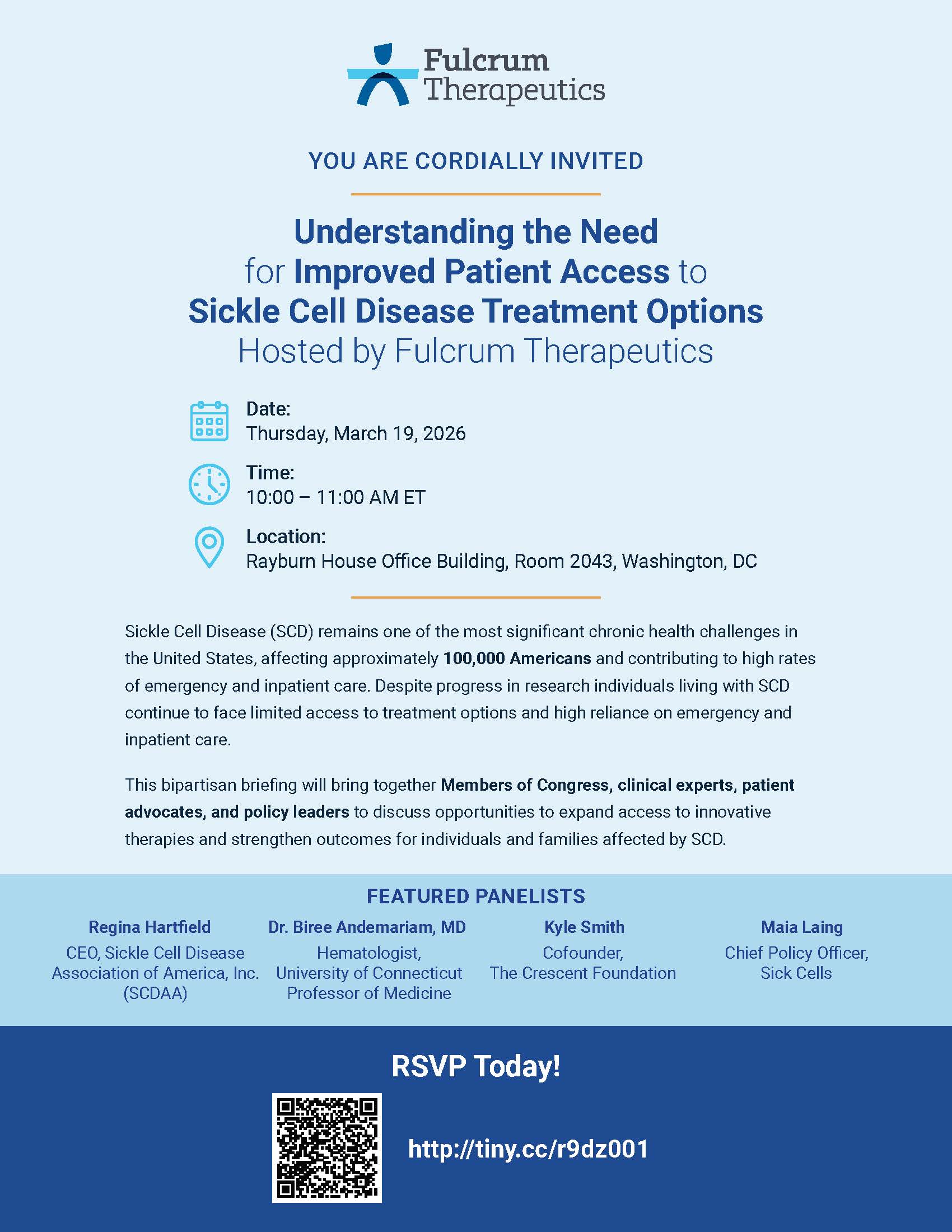
Fulcrum Therapeutics to Host Congressional Briefing

Understanding the Need for Improved Patient Access to Sickle Cell Disease Treatment Options
Hosted by Fulcrum Therapeutics

Thursday, March 19, 2026
10:00 to 11:00 AM ET
Rayburn House Office Building, Room 2043

This briefing will bring together clinicians, patient advocates, researchers, and policy leaders for a moderated panel discussion on the current treatment landscape for sickle cell disease and what Congress can do to improve access and outcomes for the 100,000 Americans living with this condition. SCDAA President and CEO Regina Hartfield is one of four featured panelists.

Sickle cell disease disproportionately impacts Black and Latino communities and remains one of the most underfunded and under-resourced conditions in federal health policy. This is a conversation worth being in the room for.

RSVP Here

Congress Passes Government Funding Bill with Big Wins for the SCD Community

Feb. 3, 2025 – Today, the House of Representatives passed a package of bills providing funding for government programs for fiscal year (FY) 2026, which runs through September 30, 2026. The President is expected to quickly sign the bill into law. All three federal sickle cell disease programs were maintained with the same funding levels as years prior. This includes:

    • $8.205 million for the Health Resources and Services Administration’s (HRSA) Sickle Cell Disease Treatment Demonstration Program
    • $7 million for HRSA’s Sickle Cell Disease Newborn Screening Follow Up Program
    • $6 million for the Centers for Disease Control and Prevention’s (CDC) Sickle Cell Data Collection Program

The package also included other SCDAA priorities:

    • The Sickle Cell Disease and Other Heritable Blood Disorders Research, Surveillance, Prevention, and Treatment Act (H.R. 1796/S. 735) which reauthorizes the HRSA SCD Treatment Demonstration Program for another five years. SCDAA has been working to advance this legislation since it was introduced in the 118th Congress – thank you to all who have advocated for this legislation and a special thanks to our Congressional champions – Senators Tim Scott (R-SC) and Cory Booker (D-NJ) and Representatives John James (R-MI-10), Danny Davis (D-IL-07), Jen Kiggans (R-VA-2), Troy Carter (D-LA-2) and Marc Veasy (D-TX-33) for helping to get this bill across the finish line.
    • The Accelerating Kids’ Access to Care Act (H.R. 1509/S. 752) which creates a process by which to streamline access to out-of-state care for children with medically complex conditions, including sickle cell disease, insured by Medicaid or the Children’s Health Insurance Program (CHIP). This legislation was championed by Senators Chuck Grassley (R-IA) and Michael Bennet (D-CO) and Representatives Trahan (D-MA-3) and Miller-Meeks (R-IA-1).

    SCDAA would like to thank the many members of the sickle cell disease community who have engaged with Congress on these bills — we could not have done this without you! We are looking forward to more advocacy in 2026.

DECEMBER 2025 LEGISLATIVE BRIEFING

Download this Briefing

2025 – AN EVENTFUL YEAR IN HEALTH POLICY AND ADVOCACY

2025 brought sweeping changes to the political environment at an intensely quick pace, including many shifts which impact the sickle cell disease community. Along with these challenges, we also saw new opportunities for the sickle cell disease community to stand together.

The year began with President Trump issuing a record number of 142 executive orders in just 100 days and articulating a new approach to federal funding for health care. Initially, we prepared for extensive cuts and a reorganization of the Department of Health and Human Services, including sickle cell disease activities, into the Administration for a Healthy America (AHA). Instead, we survived the longest government shutdown in U.S. history, lasting 43 days.

Ultimately, we did not see the creation of the AHA, and Congress passed a continuing resolution to temporarily fund the federal government at existing funding levels until the end of January 2026. All three federal sickle cell disease programs have been maintained, but advocacy for sustained federal funding will continue.

The summer was dominated by passage of H.R. 1, the “One Big Beautiful Bill Act.” H.R. 1 made the largest cuts to Medicaid in the program’s history, and over time will reduce Medicaid eligibility and enrollment, as well as limit state financing mechanisms. With implementation of H.R. 1 underway and the anticipated expiration of tax credits for Marketplace plans at the end of 2025, SCDAA will continue to prioritize access to insurance for sickle warriors in 2026. SCDAA has created this list of tips of what individuals with sickle cell disease can do now to protect their Medicaid coverage. SCDAA will continue to closely track implementation of the Medicaid changes and provide ongoing information to the community.

Protecting Medicaid and the federal sickle cell programs were the main priorities during SCDAA’s Advocacy Days in May. Thank you to all who participated – your advocacy is meaningful and raises the voice of the sickle cell disease community. These issues will persist in 2026, and SCDAA will continue its advocacy efforts. The good news is that the sickle cell community has strong champions on both sides of the aisle in Washington and a unique story to tell.

We end the year (and this article!) with huge thanks to all of our member organization leaders, individuals with sickle cell and caregivers who advocated this year on behalf of the community. Thank you for reading our many eblasts, emailing and calling your members of Congress, spreading the word to your colleagues and friends and always showing up for sickle cell.

NATIONAL ACADEMIES RELEASES FINAL REPORT ON SICKLE CELL DISEASE AND SOCIAL SECURITY DISABILITY EVALUATIONS

On December 9, the National Academies of Sciences, Engineering, and Medicine (NASEM) released the second and final report related to sickle cell disease and Social Security disability evaluations. As a result of outreach from the sickle cell disease community and members of Congress about the barriers faced by sickle cell warriors when applying for Social Security disability, the Social Security Administration (SSA) tasked NASEM with reviewing the latest published research and science and producing two reports on best practices and community experiences in the management and treatment of sickle cell disease. The interim report was released in June of this year.

SSA was specifically directed not to make recommendations, but to instead provide findings and reach conclusions on SCD. SCDAA is pleased with the conclusions included in the report and issued a statement in support of the NASEM Report and its “overarching conclusions,” which recognize:

  • There is opportunity to improve the accuracy in the determination of disability by considering the broad variation in sickle cell disease complications as well as approaches to both acute and chronic pain management, highlighting that for a number of reasons, pain is often managed at home or in a variety of outpatient care settings.
  • Sickle cell disease is stigmatized in ways that may affect an individual’s decision to seek care.
  • The frequency of treatment encounters for acute complications – whether that be the emergency department, inpatient settings or even prescribing of pain medication – is too restrictive a measure of disease severity under the current disability criteria.
  • Access to coordinated comprehensive care across the lifespan will improve outcomes. A lack of access to coordinated care makes it more difficult to obtain an accurate diagnosis and leads to a lack of documentation in medical records. Both can impact access to disability benefits.
  • Transition from adolescence to adulthood is already a challenging time for individuals with sickle cell disease. Children receiving Social Security disability benefits may need to be redetermined using the adult criteria at age 18. Navigating the differences between the child and adult criteria is challenging for individuals with SCD and their providers.

SCDAA believes this report provides additional justification with which to pursue changes to the current disability criteria for sickle cell disease. SCDAA will continue to advocate for the revision of the disability criteria to make it easier for sickle cell warriors to access these benefits.

SCDAA Response to National Academies Release of Final Report on Sickle Cell Disease and Social Security Disability Evaluations

On December 9, 2025, the National Academies of Sciences, Engineering, and Medicine (NASEM), released the second and final Sickle Cell Disease in Social Security Disability Evaluations 2025 Report. This report was completed at the request of the Social Security Administration, which tasked NASEM with reviewing the latest published research and science and producing a report on best practices and community experiences in the management and treatment of sickle cell disease. NASEM also released an interim report in June 2025.  

The Sickle Cell Disease Association of America Inc. (SCDAA), and its Medical and Research Advisory Committee (MARAC) strongly support the report’s conclusions and are eager to work with the Social Security Administration to implement appropriate and needed changes to the current Social Security disability criteria for sickle cell disease. 

This final report recognizes the broad variation in sickle cell disease and its complications as well as approaches to both acute and chronic pain management, highlighting that, for a number of reasons, pain is often managed at home or in a variety of outpatient care settings. The report’s important conclusions include: 

“There is an opportunity to improve the accuracy in the determination of disability by considering the broad variability in sickle cell disease complications and approaches to both acute and chronic pain management in a variety of settings…” 

“The frequency of sickle cell disease treatment encounters for acute complications, such as pain crises, in the emergency department and inpatient settings … is too restrictive a measure of disease severity. Growing use of alternative models of care has enabled similar levels of care in outpatient or home settings.” 

Additionally, the NASEM Report provides “overarching conclusions” related to the: 

  • full spectrum of pain and the variation in how it is experienced individuals living with SCD
  • lack of access to coordinated care
  • significant issues in transitioning from adolescence to adulthood in care, treatment and disability eligibility

The NASEM conclusions provide SCDAA and MARAC with justification to advocate for changes to the current disability criteria for sickle cell disease. 

Individuals with sickle cell disease face barriers when applying for Social Security disability and are often denied because of the overly restrictive criteria. The findings and conclusions made by this important report will enable the sickle cell disease community to initiate much needed changes.   

Sickle cell disease is a rare inherited blood disease causing red blood cells to take a sickle shape, which leads to blockages that prevent blood from reaching parts of the body. As a result, people with sickle cell complications can experience anemia, jaundice, gallstones, stroke, chronic pain, organ damage and premature death. No universal cure exists. 

Sickle Cell Disease Association of America Inc. advocates for people affected by sickle cell conditions and empowers community-based organizations to maximize quality of life and raise public consciousness while advancing the search for a universal cure. The association and more than 55 member organizations support sickle cell research, public and professional health education and patient and community services. (www.sicklecelldisease.org) 

SCDAA Receives the ASH Outstanding Service Award

SCDAA was honored to receive the Outstanding Service Award during the American Society of Hematology’s 67th ASH Annual Meeting and Exposition. The award recognizes individuals or organizations in the public or private sector who have displayed effective behind-the-scenes leadership in areas relevant to the mission of the American Society of Hematology. Congratulations to our fellow awardees, including SCDAA member organization Sick Cells and the Sickle Cell Community Consortium. Read more.

Hear SCDAA President and CEO Regina Hartfield’s acceptance speech.

Preparing for Medicaid Changes

Click here to download and print this flyer.

On July 4, 2025, President Trump signed into law a bill that cuts $1 trillion from the Medicaid program and makes sweeping changes to eligibility, enrollment processes and more. The new requirements don’t go into effect immediately – but we know they are coming. Here are some steps you can take to protect your Medicaid coverage now and, in the future, as the new requirements go into effect.

  • Know the name of your Medicaid program (some go by names like HuskyHealth, BadgerCare, Apple Health; some programs are managed by insurers like Aetna or Centene). Visit Medicaid.gov or your state’s Medicaid agency website.
  • Make sure that your contact information is up to date with your Medicaid program and make a practice of logging into your Medicaid account regularly to check for updates.
  • Sign up for access to your state’s Medicaid portal (if applicable). Check this portal often for messages.
  • Consider having a trusted family member or friend be your “Medicaid Buddy” to help you keep track of due dates, assist with application completion, remind you of enrollment periods or even attend Medicaid appointments.
  • Be sure to open all mail and emails from Medicaid and/or your state’s health department and your insurer. If you receive any communication, respond within the deadline (typically 10-30 days).
  • Begin keeping detailed records of your monthly work or qualifying activities (e.g., caregiving, school, community service). These can include pay stubs, schedules, attendance sheets, etc.
  • SCDAA encourages you to connect with your local sickle cell member organization/SCDAA Member Organization for assistance with completing the above and check the SCDAA website for further information and/or resources.